Wednesday, August 12, 2009

Up the Mosel - 8 August 2009

BeilsteinThe snorer in the next tent woke us early so we decided to make an early start to the day so got up and headed for the showers. We had not walked more than 20m from our tent when we felt the beginning of a totally different sort of shower; so it was a mad dash back to the tent to get it down and packed away as soon as, and as dry as, possible.

A misty morning Mosel momentOur next intended stop was a picture-postcard village on the banks of the Mosel, called Beilstein. We enjoyed a coffee in a dry cafe while waiting for the rain to pass and then wandered around the town which would look much more attractive in the sun, than in a foggy mist.

Trier CathedralWe swapped from bank to bank, following the Mosel upstream and stopped off again at Zell for another wander and coffee before heading further upstream to Trier. Although a Cetlic settlement for 1300 years before the Romans arrived, it was Constantine who really put it on the map. He made Trier the capital of the Western Roman Empire and built a massive Basilica and huge bath complex.

Porta NigraThe symbol of the town is the Porta Nigra which is the most impressive Roman fortification in Germany and has survived only because a pious Greek recluse lived here and a monastery in his honour was founded there along with a church. The huge structure is held together without mortar, using iron pegs to join the stones.

Roman bathsConstantine's Basilica is the largest intact Roman structure outside of Rome and is really very impressive. What remains of Constantine's bath complex is also amazing and it is a pity that more of it has not survived the ravages of time and scavengers.

Cathedral alcove ceilingFurther still up the Mosel we found a very humble camp site with the bare minimum of facilities, not the most impressive last memory of German camping. By contrast, our last German meal was very memorable. In the little village by the camp site was a Guest house that also had a restaurant. Given the number of cars outside it was clearly popular with the locals; we soon found out why.

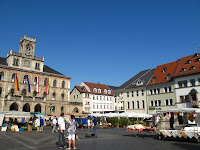
Trier town squareWe enjoyed a wonderful meal with a non-tourist price tag and the wine even came from the restaurant proprietors own vineyard/winery.

Tuesday, August 11, 2009

Down the Rhine - 7 August 2009

RudesheimRudesheimRudesheim was described in one guide book as “a nostalgia trip for geriatric tourists” and really only has one “cute” street to its name; and a very cute, narrow, street it is; but it really is not worth making a detour to see compared to many of the other lovely towns we have seen on this trip.

RudesheimNevertheless we paid our tourist homage and left behind some tourist Euros for our morning coffee; then left to head down the north bank of the Rhine.

Our first stop was at Marksburg Castle, one of the three authentic medieval castles in the area; most of the others dotted along this Marksburgsection of the Rhine have suffered romantic “modern” 18-19th C updates. Marksburg is presented and furnished as it would have been 500 years ago, and you are allowed to take photographs inside, which is most unusual; and it was as we were taking one of the photographs that the time and date of 12:34:56 7/8/9 passed quietly by.

MarksburgThe Castle tours are only in German but we had a guide book with the salient features described for us so we were not too disadvantaged, apart from the fact that the German tour guide was cracking a lot more jokes than our English guide book, judging by the reactions of her audience.

Leaving the Rhine at Koblenz we changed river valleys to the Mosel and headed off upstream to the next castle that was tucked away, seemingly, in the middle of nowhere, but apparently on an ancient trade route. It is well worth making the detour to find The Rhine: Castles and CruisesBurg Eltz as it is in a choice position situated on a rocky promontory in a wooded valley with a river running around three sides.

The castle has been in the same family for 800 years or 33 generations and way back, when the family split into three branches they decided to build the castle with three family Burg Eltzdwellings in a roughly triangular fashion on the top of the rock and live in a communal fashion. The castle was very progressive with “en-suite” bathrooms in ¼ of the 80 rooms, many of them flushed with rain water. They had glass in the windows when glass was still very expensive and so on; they lived very comfortably for the times and remained unconquered for most of their history.

The climb back from Burg Eltz to the car park was rather Cochemwearying on such a warm afternoon so after dropping back down to the banks of the Mosel we stopped at Cochem for a wander around and some much needed refreshment. Cochem is an overly touristy town so we crossed the Mosel and pulled into a campsite on the bank of the Mosel at Bruttig-Fankel.

On the Rhine - 6 August 2009

BacharachLeaving our picturesque, but rather noisy, campsite we set off up the Rhine to St Goar to catch a Rhine river boat cruise. But, having looked at the timetable, we decided we would fit more into the day if we drove further upstream to Bacharach and caught the boat from there.
Rhine CastlePfalz Castle

Rhine CastlesWe had time to explore a little of Bacharach before the boat sailed taking us on a leisurely look at what is reputed to be the best part of the Rhine. The schedule allowed us either an hour-twenty or two hours-twenty before a return sailing.

We climbed the hill behind St Goar to the Burg Rheinfels, a romantic ruin on the skyline. Once a huge and powerful citadel it is now a ruin providing Burg Rheinfelswonderful views over the Rhine. We finished the castle and realised that we had 20 minutes to get back to the wharf or we would have to fill in another hour. We made it, just – even managing to buy a drink on the way back through the main street.

BacharachAfter a pleasant, relaxing, return boat trip we spent a little more time finishing off our exploration of Bacharach before driving on to find the first bridge back across the Rhine and then headed back up the other side to Rudesheim where we found our next campsite on the banks of the Rhine.

The Fourth Bridge - 5 August 2009

WeimarThe reason we had detoured some little distance out of our way to be near Erfurt was so we could “collect the set”; but more of that later. On the way between our campsite and Erfurt we made another small detour to visit Weimar; probably not for the same reason that all the German tourists were visiting. We went because it is a UNESCO World Heritage listed town, although why we are not sure. ErfurtIt is famous for being home to Goethe, Shiller, Liszt, Bach, Strauss, Nietzsche and others and of course for giving its name to the short-lived Weimar Republic.

Although a pleasant enough spot for a coffee stop we had seen better towns on this trip that would seem more worthy of a UNESCO listing so we moved on to Erfurt, once again frustrated in our initial attempts by road closures.

KramerbruckeErfurt is home of the Kramerbrucke; a bridge lined on both sides with shops that gives no indication as you approach that you are anywhere other than on a normal city street. There are four bridges in the world with shops on both sides and today we collected the set as we crossed the last of the four. (Rialto, Venice; Ponte Vecchio, Florence; and Pulteney Bridge, Bath are the other three.) Kramerbrucke may not be the most well known but it is most appealing.

Although we had really come just for the bridge, we spend a pleasant few hours exploring this delightful centre that has survived in its current state mainly because it was behind the Iron Curtain when the rest of the world was in “tear down and modernise” mode.

Inside the RathausHowever, we had now strayed a considerable distance from our intended path so it was back on the autobahns for a dash down to the Rhine Valley and our next campsite, just outside of Koblenz. When not slowed for the all-too-frequent road improvement works, the German autobahns are a real pleasure to drive: slower drivers understand about moving to the slow lanes rather than hogging the centre or fast lane as they do in the UK and when there are no The first upstairs church we have walked under, at the end of Kramerbruckelimits posted, anything goes.

Cruising at around 100mph there are still many cars that pass you as though you are standing still and you have to be ever watchful when pulling out to pass as these vehicles fill your rear view mirror at an alarming rate.

WeilburgContinental summer was at its best with shade temperatures in excess of 30C so we stopped off at Weilburg, on a bend in the River Lahn, for a refreshing Iced Coffee before completing the final leg to our delightful campsite, on the banks of the River Lahn, just before it feeds into the Rhine.

Wurzburg & Bamberg - 4 August 2009

ResidenzOur campsite had been chosen to afford easy access to Wurzburg in the morning and so we had no trouble getting parking directly in front of the Bishop's Residence, a UNESCO World Heritage listed building.

As seemed to be the way with these chaps, the Prince Bishop had Alte Mainbruckeindulged himself in a totally over the top Baroque extravaganza. The plaster-work was amazing and it is distressing to realise that it was mostly destroyed in an Allied bombing raid and has had to be lovingly and painstakingly restored to the fabulous state it is in today.

Fortress MarienburgWe were particularly impressed with the Green Lacquer Room. This has green lacquer applied over silver foil which gives it a glow. It also has opposing mirrors on all four walls, compared to just two walls in most of the other rooms. Consequently, one can stand in the centre of the room, on an amazing work of inlaid flooring, and see one's reflection disappearing off in all four directions.

Altes Rathaus, BambergYou get to see a good number of rooms for the admission fee and by being early seemed to have most of the rooms to ourselves. The gardens are also worth a visit but not quite on the scale of some of the other royal residences and palaces we have visited.

Leaving the Bishop's Residence we wandered around the old town before ending up at the second oldest bridge in Germany, Alte Mainbrucke, which gave great views up to the Fortress Marienburg on the hill.

Altes Rathaus, BambergBack in the car we sped across to Bamberg to look at another UNESCO World Heritage site, this time the entire old town. There are a couple of islands and a number of old bridges to add interest to the walk around the old town centre. The Dom is interesting in that it is double ended, with a Choir at both ends, built some centuries apart in totally different styles.
'Little Venice', Bamberg
Having had our fill of Bamberg it was back in the car for another dash along the autobahns to our next campsite near Erfurt.

Monday, August 10, 2009

The Romantic Road II - 3 August 2009

NordlingenWe had not gone 100m from our hotel when we found our intended route blocked by road works. This turned out to be a portent for the day as we encountered seven barricades across our path through the day. Thankfully, after a few “in one hundred metres make a U-turn” suggestions the sat-nav finally found a way around most of them. Two were across bridges barring our way into towns that we had diverted to see (in one case about 20km) but we did not bother to find another way across the river.

WallersteinOur first stop was at the epicentre of a meteor strike a few aeons ago; Nordlingen. This basically circular town, in the centre of the largest meteor crater on earth (25km diameter), is the only one left in Germany with a complete circuit town wall walk; of which we complete about a half before cutting back across the centre of town to check out the church, the largest building on earth made of Suveite, a stone created by the meteor impact.

DinkelsbuhlBack on the Romantic road we headed north through Wallerstein to Dinkelsbuhl, an easily accessible, relatively tourist free, extremely attractive town, for a coffee and a rather better Black Forest Gateau.

The view from the topA must-stop destination on the Romantic Road is Rothenburg ob der Tauber. The old town hall tower is worth the climb and the €2 cost for the views from the top. The access was definitely designed for a solitary bell polisher rather than the many tourists who were vying for use of the narrow steep stairs.

Wooden carved altarSt Peter wearing spectacles
Also worth the €2 entry was the St Jacob's Church to see the 500 year old wooden carved altar. This magnificent piece, carved by the “Michelangelo of German wood carvers” was made to hold a piece of rock crystal which contains a scrap of fabric “miraculously stained in the form of a cross by a drop of spilt communion wine.”
Rothenburg ob der TauberRothenburg ob der Tauber
Another notable sight is a picture of St Peter wearing spectacles painted on the High Altar at the front of the church.

Rottingen RathausOutside we enjoyed a pleasant stroll around the town before setting off to find towns that were barred to us by road works. We did manage to call through Creglingen and Rottingen before finding our camp site for the night, just beyond Wurzburg.

The Romantic Road I - 2 August 2009

Forsaking our country idyll and its tuneless bovine chorus we headed back to Fussen and the castles. There is a wonderful view to be had overlooking Neuschwanstein Castle The bovine bell clangersbut the guide book told us it was a 2-hour round trip from Marienbrucke and the driving instructions for the day we were here previously said it was a full day's drive so we did not attempt to fit the two-hour walk into that day. As it turned out, we were misled on both counts. It was not a full day's drive and we made it up to the view, took our photos and were back to the bridge in 50 minutes this morning.

Neuschwanstein CastleUnfortunately we did not start from the bridge, we had to make the climb from the village once again and because we did not want to pay the high car-park charges we parked a little way out of the village making the whole trip car to view and return in two hours of energetic walking.

WieskircheWieskirche
While that view was “energetic” the next was restful and contemplative as we stopped at the Wieskirche. This World Heritage site is a riot of Baroque decoration gone totally over the top.
Wieskirche ceilingThe statue that wept

A statue of Christ supposedly wept in 1765 and the humble little chapel that held the statue could not cope with the Donauworthcrowds of pilgrims that flocked to see the statue so the church fathers commissioned a new, larger church; the building of which coincided with the height of the Baroque fashion. It is absolutely amazingly astonishingly astounding.

These two sites lie at the southern end of the Romantic Road and it was this that we followed for the rest of the day; stopping at Landsberg am Lech, Freidberg, Augsberg and Donauworth of which Freidberg was not worth the detour. Other towns at the southern end of the Romantic Road were just drive-bys.
DonauworthDonauworth
Of the ones we stopped at, Lansdsberg am Lech was the nicest although they all would have looked better in the sunlight rather than in the intermittent rain.