Saturday, February 13, 2010

Computer and other Art – 6 February 2010

Road view of V&AInternal courtyard of V&A
Computer art exhibitionThe V&A have a very interesting computer art exhibition at present. Most exhibits are interactive and many reflect the viewer in different ways. The manner of participating ranges from lights mimicking actions, to being able to capture photographs to participate in the exhibit.
Computer art exhibition Computer art exhibition
Fake 'ancient Egyptian' Coffin Mask sold for $5000The police also have an exhibition of art fraud. This was particularly interesting, as we remembered one of the cases, when a couple of years ago the Greenhalgh family were arrested. The son made the fakes, many with elaborate and convincing provenances, while his parents marketed them for him.

V&A RestaurantOne of the most delightful areas of the V&A is the restaurant/cafe. It is definitely worth taking a coffee break, just to enjoy the wonderful dining area which is entirely covered in ceramic tiles. This tile work is part of the original design of the museum and a glimpse of what the designer intended for the entire building, had funds permitted.

Tuesday, February 02, 2010

Winter at the beach – 31 January 2010

Ramsgate
We followed the sunshine to Ramsgate in Kent, which is due east from London. The winter is the ideal time to visit the seaside here, as the roads must be absolutely jammed in summer, with limited parking once the town is reached. Today the coastal town sparkled in the sunshine, and we enjoyed a pleasant walk around Ramsgate, and it's neighbour – Broadstairs.
RamsgateWhite Ness
Charles Dickens frequently stayed in Broadstairs, and wrote his novel Bleak House while staying in the house at the end of the cliffs. This town has a very pleasant traffic free beach promenade.
Broadstairs
Shell Grotto, MargateWe finished the day at Margate, which rather lacks the appeal of it's neighbours. But tucked away behind the town is a shell grotto, which is interesting to visit. It was discovered in 1835, and no one knew of it's existence before then. There are some theories that suggest it dates back to Roman times, or maybe it was built by a secretive eccentric.

Thaxted - 30 January 2010

Thaxted Guildhall
ThaxtedOne of the delights of winter is walking on a frosty morning over wet farmland, frozen solid.

We needed to give our flat battery a good run, so decided to visit Thaxted,

Thaxted is totally delightful. A colourful High Street, Thaxted Windmillwith the painted pargetted and timber framed buildings leading the eye to the large, elaborate church, past a very stylish 14th century Guildhall. Behind the village is a windmill, still in working order.

ThaxtedOur 9 mile circular walk turned back at Great Easton, a smaller, but quite charming village, set around a green.

The day was mild, despite the frost, and stayed sunny all day; one of winter's gems.

Great EastonGreat Easton pargetting detail

Sunday, January 24, 2010

Hammersmith – 17 January 2010


In contrast to yesterday, today was sunny, and even warmer, reaching a balmy 10deg.

A circular walk from Hammersmith, mostly along the Thames, was very enjoyable, until the camera battery ran out. So after admiring the recently cleaned church in Hammersmith, and the bridge, I was unable to record all the cox eights, out in the early morning, practicing. The river is lined with rowing clubs.

The walk went from Hammersmith to Barnes and back via Fulham Palace. This Tudor palace is now open to the public, a very quiet and tranquil place with a largely neglected garden, beside the Thames.

London Ice Festival - 16 January 2010


Last Saturday would have been an excellent day for the London Ice Festival, with the cold temperatures and crisp, fine sunny day. Unfortunately the Festival was today, and the weather turned a little warmer, but more to the point, very wet.

The five teams of carvers worked all day in rain, finishing the sculptures that were started yesterday. They started with 2m blocks of ice, with a theme of 'Cool Trading'.

Saturday, January 09, 2010

From 'summer' to winter – 3 January 2010

Snowy mountains behind Heraklion - preparation for London?
Archaeological Museum, HeraklionOur final day in Crete was again beautifully warm and sunny. We were told by the rental car rep at the airport, that it was the warmest Christmas for 100 years. She was not impressed, but we have been delighted.

We spent the first half of the morning in Heraklion, at the Archaeological Museum. Unfortunately it only has a small display open at present, as the museum is being redeveloped. But the best of their artefacts are on display, and it is amazing to see items that have been recovered from the sites we visited.
Archaeological Museum, HeraklionArchaeological Museum, Heraklion
monastery near GourmesBefore returning to enjoy the sun on our apartment balcony, we detoured to see a renovated monastery nearby, which other guests had recommended. Apparently the bishop in charge was credited with many miracles, and money obviously poured in to redevelop the original monastery. The new monastery is amazing, but we were told the bishop is truly a man of God,Roadside shrineand has moved away from the crowds to a more secluded monastery elsewhere in Crete.

The whole time we were in Crete, the warm 'summer' weather made us long for an ice-cream. But no one stocks them in the off season. So waiting in Athens for our un-hurried connection to London, we at last were able to have an ice-cream, before flying from the high 20s to the sleet and snow showers of London.

Through the interior – 2 January 2010

Agia Galini
Church of the Panagia, MeronasThe main road to the south coast, took us to a Agia Galini, a very attractive seaside town. After walking the town & enjoying a coffee beside the harbour, we set off on a circular drive around the Amari Valley. This drive would be difficult without the detailed instructions in the AA Crete guide book. Large holes on Amari Valley road near Hordaki
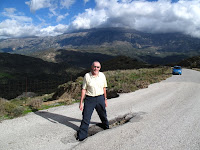


We felt as if we had seen the real Cretan village scene, after completing the 100k round trip.
Kouroutes
Many of the villages had a war memorial, which in particular remembered the German slaughter of these villages, just the same as Anogia. Most of the houses have been rebuilt, as whole villages were destroyed, along with schools and even cemeteries.
Byzantine church near Ano MenoaDetail on Church of the Panagia, Meronas
Venetian tower, Amari villageThe villages had real charm, from a distance, and were spaced about every 5k around the valley perimeter. Many had Byzantine churches, and one anomaly was a Venetian tower which we were able to climb for a rather windy view.

At the end of the drive, we visited another nearby coastal town - Matala. The interesting feature is the catacomb caves cut into the cliffs as long ago as Roman times, and lived in down through the centuries until the 1960s.

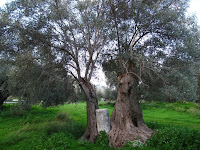
Sea cliffs at MatalaDuring our time on Crete we saw various ruins on our travels, and after leaving the coast, we passed two more extensive sites. The first was Faistos, a Minoan palace, and Gortys, a Greco-Roman city. Both sites were closed by the time we arrived, but what could be seen from the road was interesting, especially a 1,600 year old protected olive tree at Gortys, which has grown around a Roman pillar. Both are so old now, we weren't sure which was holding the other up!
Minoan palace at FaistosOlive tree at Gortys